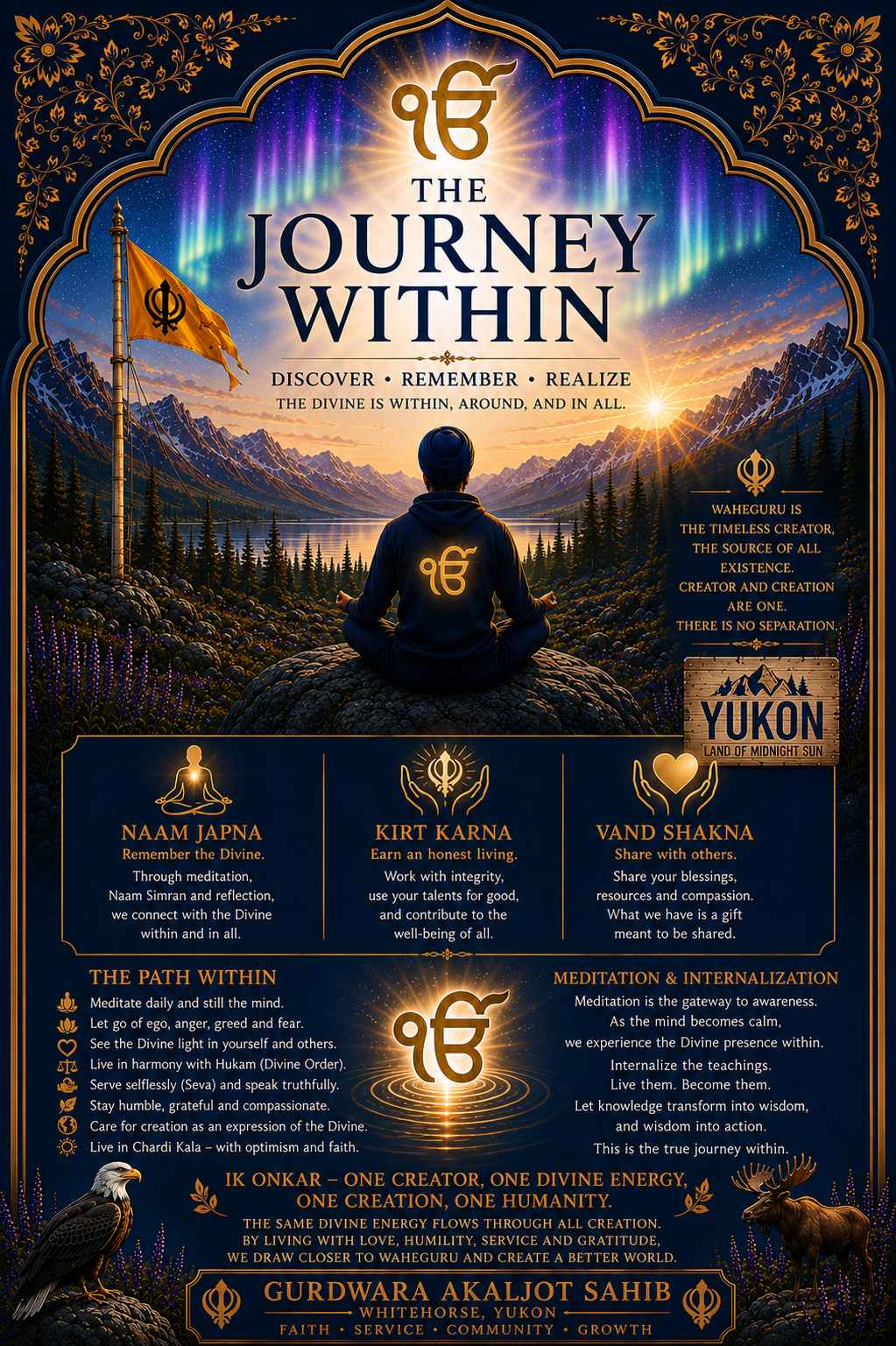
Sikh teachings encourage us not only to look outward but also inward. Through meditation, reflection, and Naam Simran, we begin the process of internalization—bringing the teachings of the Guru from our minds into our hearts and daily lives.
A Reflection from Gurbani
ਮਨ ਤੂੰ ਜੋਤਿ ਸਰੂਪੁ ਹੈ ਆਪਣਾ ਮੂਲੁ ਪਛਾਣੁ ॥ Man tūṁ jot sarūp hai āpṇā mūl pachhāṇ.
"O mind, you are the embodiment of Divine Light; recognize your own origin." — Guru Granth Sahib, Ang 441
This profound teaching speaks directly to self-realization, consciousness, and discovering the Divine within—the very essence of The Journey Within. Guru Sahib reminds us that the journey toward the Divine is not a journey outward but inward. The Divine Light we seek already resides within us. Through meditation, reflection, and remembrance of Waheguru, we gradually uncover our true nature and our connection to the One Creator.
Meditation is more than repeating words; it is the practice of becoming still enough to experience the Divine presence within. As the mind becomes calm, we begin to see beyond fear, ego, anger, greed, and attachment. We become more aware of the same Divine Energy flowing through ourselves, others, and all creation.
"The Creator permeates and dwells within every heart."
As our awareness deepens, we begin to recognize that the Divine is not distant. The same Divine presence exists within every person, every living being, and throughout creation itself. What appears separate is, in truth, connected through the One Creator.
Internalization transforms spiritual knowledge into lived wisdom. Instead of merely reading about compassion, we become compassionate. Instead of talking about humility, we become humble. Instead of seeking the Divine outside ourselves, we begin to recognize the Divine Light already present within.
The goal is not to escape the world but to live fully within it—grounded in remembrance, guided by Hukam (the harmony and order through which creation unfolds), and connected to all creation through Ik Onkar.
Living the Sikh Way
Remember Waheguru daily.
Practice Naam Simran and meditation.
Live in harmony with Hukam (the harmony and order through which creation unfolds).
"The Divine Light is within all; that Light is the same."
When we truly recognize this truth, divisions begin to disappear. We see the Creator reflected throughout creation and understand that all life is interconnected through the same Divine Energy. The mountains, forests, rivers, wildlife, and humanity are all expressions of the same Divine reality.
Reflection
The journey within is ultimately a journey toward recognizing what has always been present. Through Naam Simran, meditation, selfless service, and living in harmony with Hukam (the harmony and order through which creation unfolds), we gradually realize that the Creator and Creation are intimately connected.
As Guru Nanak Sahib teaches:
ਪਵਣੁ ਗੁਰੂ ਪਾਣੀ ਪਿਤਾ ਮਾਤਾ ਧਰਤਿ ਮਹਤੁ ॥ Pavan Guru, Pani Pita, Mata Dharat Mahat.
"Air is the Guru, Water the Father, and Earth the Great Mother." — Guru Granth Sahib, Ang 8
This reminds us that all creation is sacred and sustained through the same Divine presence. The journey within therefore leads us not away from the world, but into a deeper relationship with it—seeing the Divine within ourselves, within others, and throughout creation.
Ik Onkar — One Creator, One Divine Energy, One Creation, One Humanity.
The same Divine Energy flows through all creation.
Waheguru is the timeless Creator, the source of all existence, life, and consciousness. Sikh teachings describe a time when only the Divine existed in the state of Sunn—a profound stillness beyond form, space, and time. From this state of infinite creative potential, through Divine Hukam (Order), emerged the countless galaxies, stars, planets, and forms of life that fill the universe today.
The vast Yukon wilderness offers a glimpse into this wonder. The mountains, forests, rivers, Northern Lights, and endless skies remind us that creation is not separate from its Creator. The same Divine Energy that transformed non-matter into matter and brought the universe into existence continues to sustain it today. Every star that shines, every tree that grows, every creature that breathes, and every human heart that beats exists within this Divine Energy and according to Hukam.
Sikh philosophy teaches that the Creator and Creation are intimately connected. The Divine is not distant from the universe but present throughout it. The same Divine Energy flows through every galaxy, every mountain, every river, every living being, and every atom of existence. What appears separate to our eyes is, in reality, part of one interconnected whole. Creation is the expression of the Creator, and the Creator is present within creation. Through Ik Onkar, we recognize the underlying unity that binds all existence together.
This Divine Energy is constant and eternal. It is not created or destroyed but continually manifests through countless forms within creation. The elements that form the mountains, rivers, forests, animals, and human beings are all part of the same interconnected reality. The universe is not a collection of isolated objects but a living expression of Divine presence. All existence is woven together through the thread of Ik Onkar.
The rhythm of the seasons, the movement of the planets, the cycle of birth and renewal, and the harmony found throughout nature all reflect Hukam—the Divine Order governing the cosmos. When we learn to live in harmony with Hukam, we cultivate humility, gratitude, peace, and acceptance. We begin to see ourselves not as separate individuals, but as participants in a vast and beautiful creation sustained by the same Divine Energy.
Standing beneath the Northern Lights or gazing into the endless Yukon sky, we are reminded of both our smallness and our connection to something infinite. The same Divine Energy that illuminates the stars also shines within every living being. By remembering Waheguru, we learn to see the sacred in all things and to live with wonder, compassion, and reverence for the gift of existence.
Ik Onkar — One Creator, One Divine Energy, One Creation, One Humanity.
The same Divine Energy flows through all creation.
Translation: “First, the Creator created the Divine Light; from it, all beings were made. From the One Light, the entire universe was born — so who is good and who is bad?” — Guru Nanak Dev Ji, Guru Granth Sahib (Ang 1349)
From Pioneers to Community
Faith • Service • Oneness
Equality of All Humanity
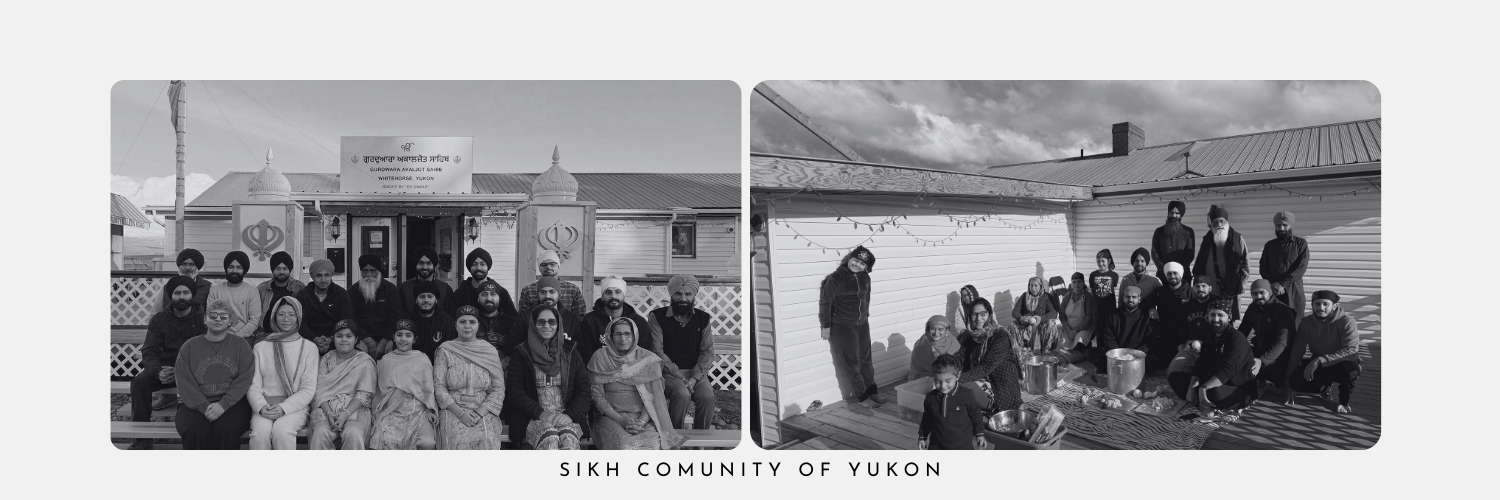
The Sikh community, though modest in number, has made meaningful contributions to the cultural, social, and civic life of Yukon. Over the past several decades, Sikh families have helped strengthen the community of Whitehorse by living the core Sikh principles of seva (selfless service), equality, humility, and unity. Their presence reflects the values of compassion, service, and openness that are deeply rooted in Sikh teachings.
Community Building and Cultural Diversity
Sikh Community of Whitehorse
Sikh residents have played an important role in enriching Yukon’s multicultural identity. Through cultural events, educational outreach, and open community gatherings, they have helped introduce Yukon residents to Sikh traditions and values.
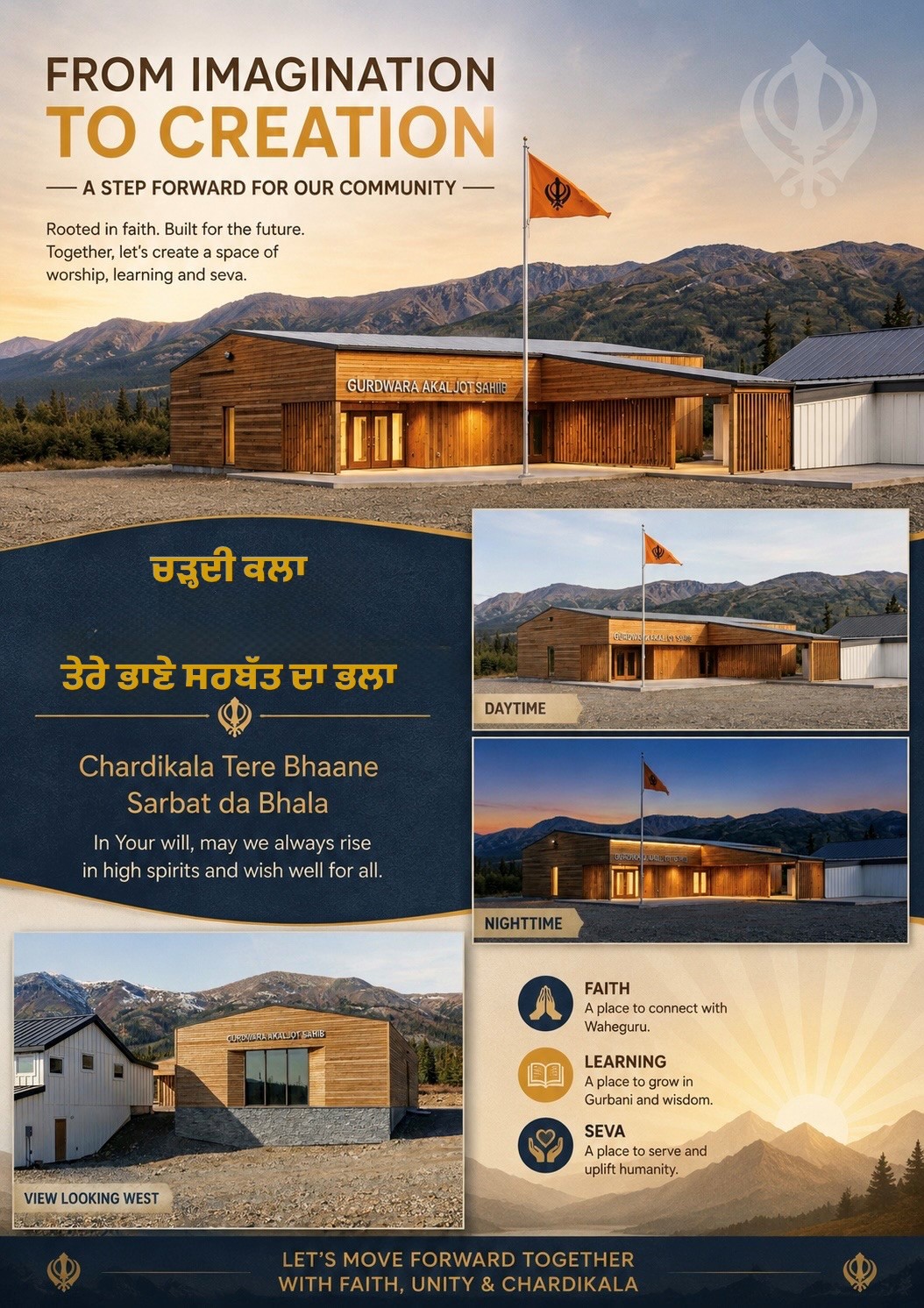
At the heart of this community life stands Gurdwara Akaljot Sahib, the first Sikh place of worship in Yukon. The Gurdwara serves not only as a spiritual sanctuary but also as a welcoming space for people of all backgrounds. It reflects the Sikh belief that all humanity is equal and that the doors of the Gurdwara are open to everyone.
Service and Volunteerism
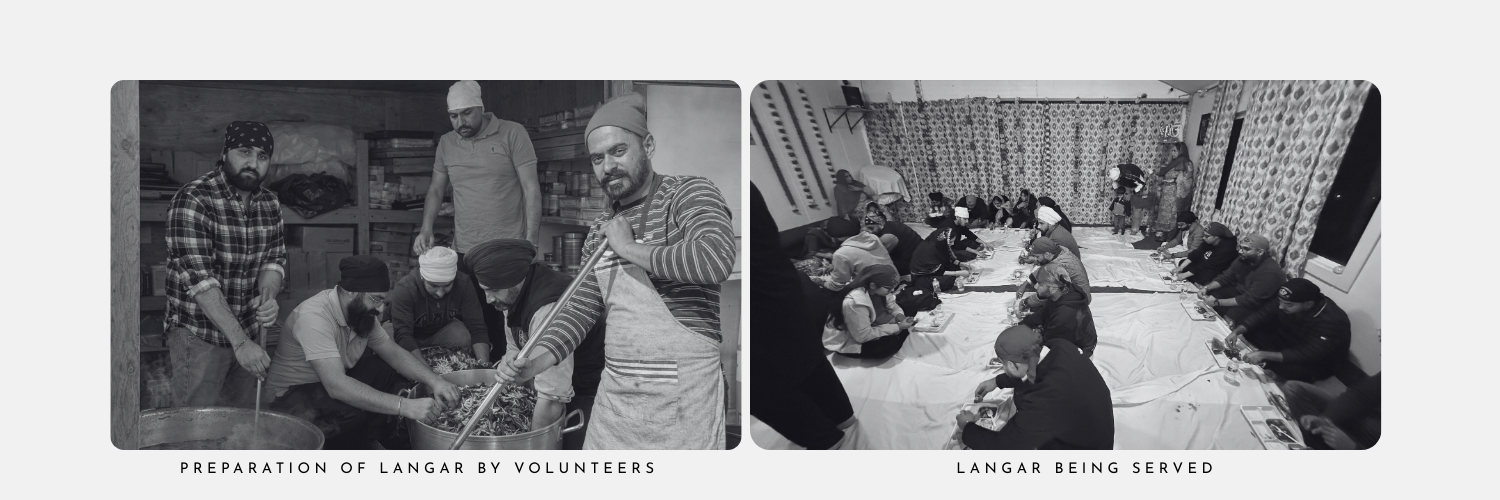
Service to humanity is central to Sikh teachings. Members of the Sikh community in Yukon actively contribute through volunteer work, organizing community events, supporting charitable initiatives, and offering hospitality through the tradition of langar, the free community kitchen where meals are shared by all without distinction.
The Legacy and Contributions
A key figure in the development of Sikh life in Yukon was Joginder Singh Grewal, whose life reflected a deep commitment to service, humility, and the Sikh principle that all humanity is one. Through his actions and philosophy, he helped shape both the Sikh community and the broader civic life of Whitehorse.
Joginder Singh Grewal played an important role in supporting the growth and establishment of the Sikh community in Whitehorse, particularly in helping build and sustain Gurdwara Akaljot Sahib. For many Sikh families living far from larger communities in southern Canada, the Gurdwara became more than a place of worship—it became a spiritual home and a place where culture, language, and faith could be preserved in the North. His dedication and encouragement helped ensure that future generations would have a gathering place rooted in Sikh values of equality, service, and community.
Beyond religious life, Joginder Singh Grewal became widely known throughout Yukon for his remarkable public community garden in Whitehorse. Over many seasons, his garden became a symbol of care for the land, generosity, and community pride. His work in public gardening earned national recognition in 2015, when the organization Communities in Bloom honoured him for his outstanding public garden in Whitehorse. The recognition highlighted not only the beauty of the garden itself, but also the spirit of dedication and community stewardship behind it.
His impact was formally recognized after his passing when the Yukon Legislative Assembly paid tribute to his life on April 23, 2024. During the tribute, members of the Assembly acknowledged the profound influence he had on the Yukon community:
“Joginder was an inspiration and mentor to me and to many Yukoners… for his thoughtful, insightful, and contemplative life philosophy, his masterful public gardening over so many seasons, and his purposeful active living for almost 100 years. He was a pillar of the Yukon Sikh community and he will be sorely missed.”
This recognition reflected how deeply he touched the lives of those around him—as a former Flying Officer, a community gardener, a mentor, and a respected elder within Yukon’s Sikh community.
Joginder Singh Grewal – A Life of Service
Guided by the universal principles of Sikhi, Joginder Singh Grewal lived a life grounded in humility, hard work, and selfless service. From his early journeys to Canada in the 1960s, at de Havilland in Downsview, Ontario, to his later years in Whitehorse, he remained deeply devoted to community and faith. In his final days, he continued to perform sewa at Gurdwara Akaljot Sahib, embodying the Sikh values of compassion, equality, and service until the very end.
Joginder Singh Grewal’s philosophy of life also left an impression in academic research. In her thesis “Dynamics of Ethnic Identity Negotiation: A Case Study of Indian Punjabi Immigrants in Whitehorse, Yukon,” researcher Catherine K. R. Larsen observed something unique about him during their conversation:
“Joginder is an interesting exception because throughout almost two hours of conversation, not once did he refer to himself, his family, or any other individual by an identifier that denoted nationality, religion, ethnicity or race.”
This observation reflected Joginder’s deeply held belief that human connection transcends labels and divisions. His outlook closely reflects the spiritual message found in the Guru Granth Sahib, which teaches that all people are part of one human family under the oneness of the Creator.
In this way, Joginder Singh Grewal embodied the Sikh concept of Ik Onkar — the unity of all existence. Whether through helping establish the Gurdwara, tending a garden that brought joy to the community, mentoring younger generations, or simply sharing conversation with neighbors, he demonstrated that the true measure of a life is found in service, humility, and connection.
Today, his legacy continues through the community he helped nurture and through the family and friends who carry forward his belief that human connection is the truest expression of faith.
Education and Interfaith Outreach
“Sharing Sikh Values Through Education and Dialogue”
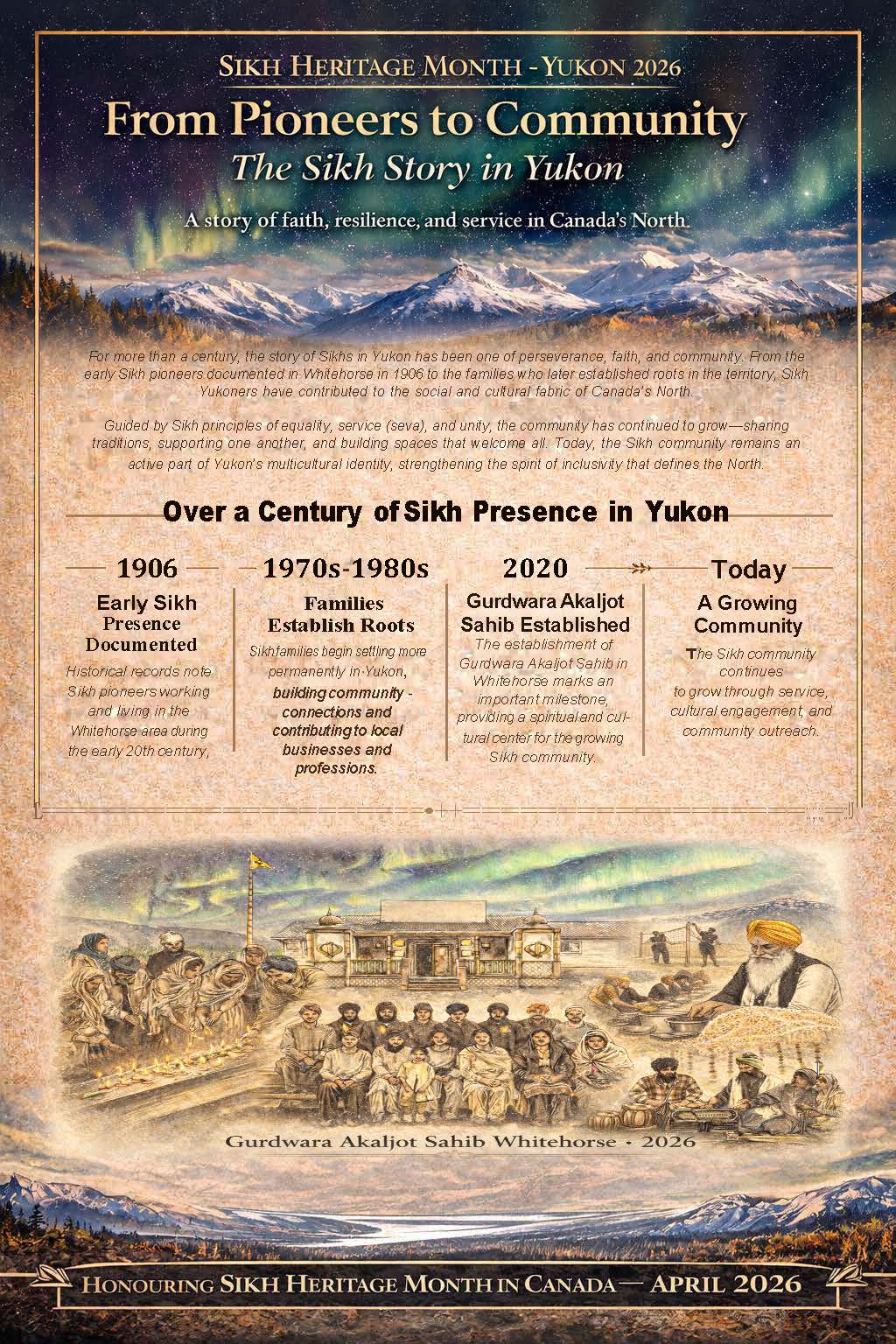
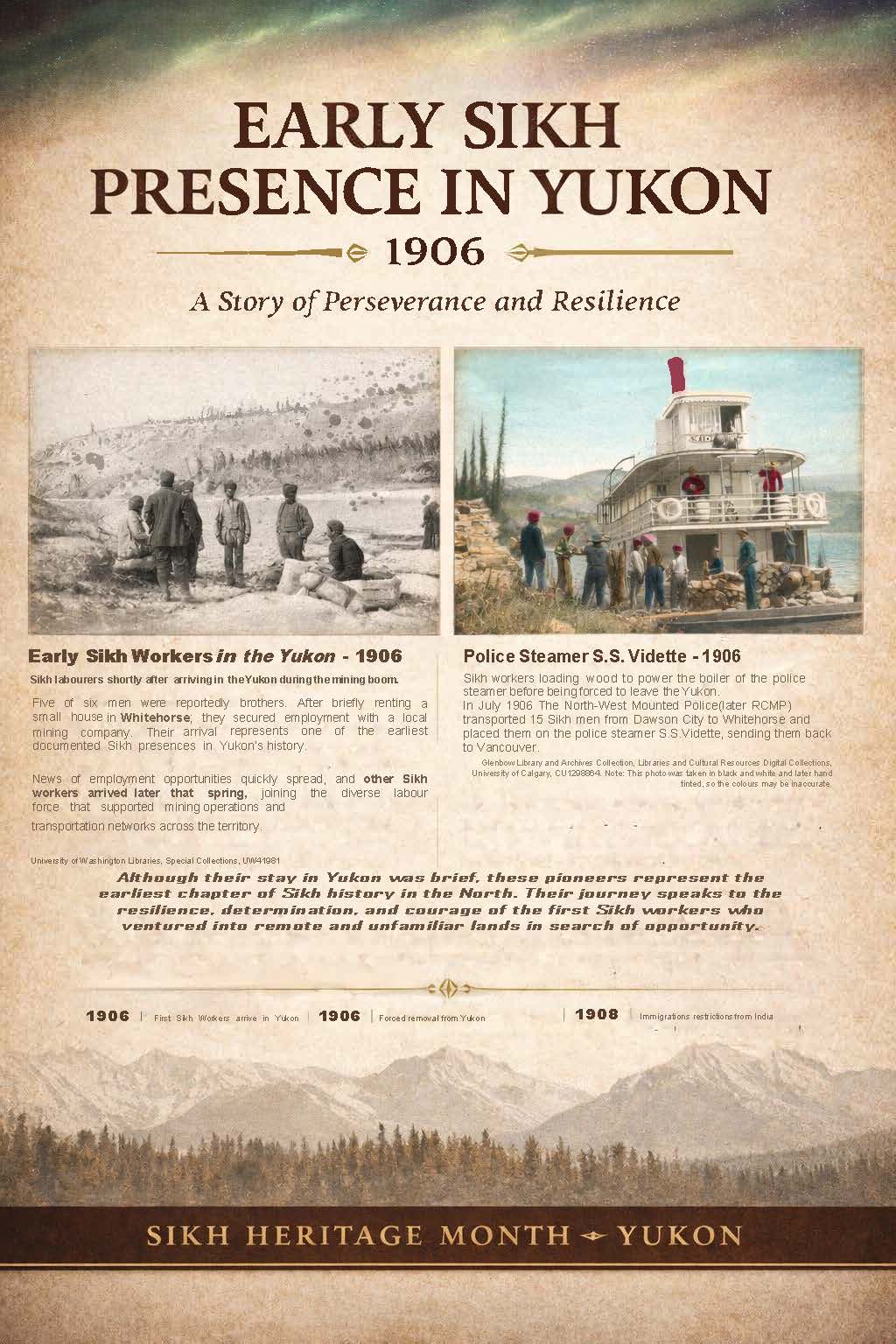
From the early Sikh pioneers documented in Whitehorse in 1906 to the families who later established roots in Yukon during the 1970s and 1980s, the Sikh story in the North has been one of resilience, community building, and service. The establishment of Gurdwara Akaljot Sahib provided a spiritual and cultural home for the growing Sikh population, continuing the tradition of openness, hospitality, and community engagement that has long defined Sikh life in Yukon.
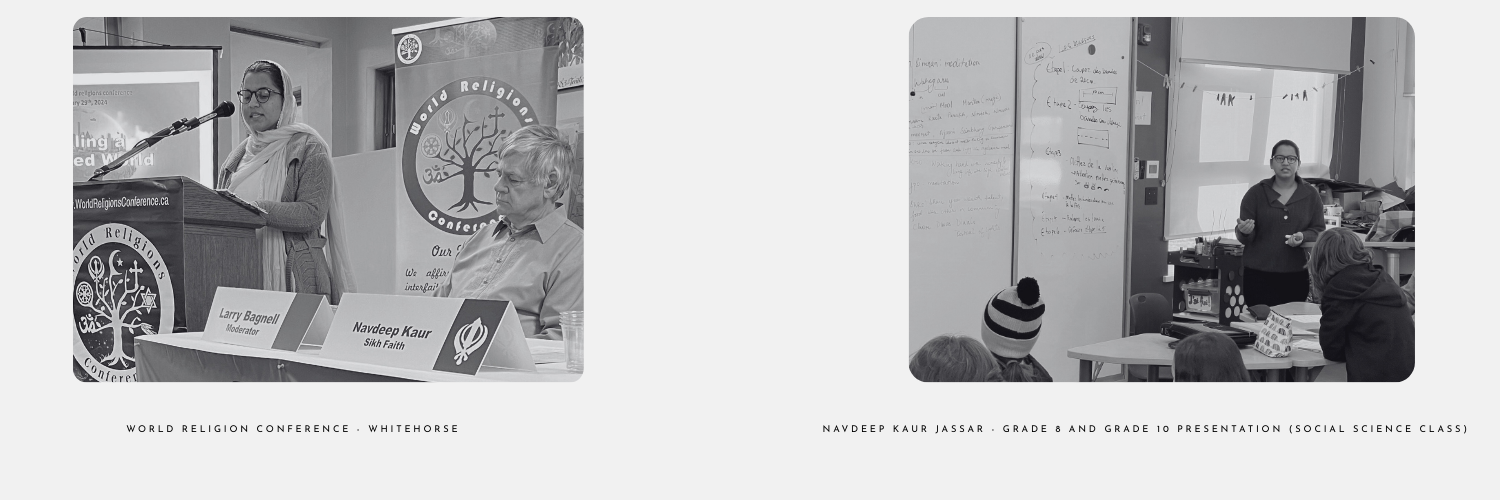
Today, that spirit of service extends beyond the walls of the Gurdwara through education and interfaith dialogue. Community member Navdeep Kaur Jassar has contributed to this effort by sharing Sikh values with the broader public through both interfaith forums and classroom learning.
Navdeep has represented the Sikh faith at the World Religions Conference, where she spoke about Sikh teachings in the context of fostering understanding in a diverse society. In these discussions she highlighted core Sikh principles such as equality, service, and the belief that all humanity shares the same divine light.
She has also visited Grade 8 and Grade 10social studies classrooms in Yukon schools, introducing students to Sikh history, identity, and teachings from the Guru Granth Sahib. Through these presentations, students learn about the Sikh concept of oneness of humanity, encouraging respect and curiosity about different cultures and traditions.
In many ways, these efforts continue the legacy of community leaders like Joginder Singh Grewal, whose life reflected the Sikh values of humility, service, and unity. Through education, dialogue, and community engagement, the Sikh community in Yukon continues to contribute to a more inclusive and understanding society.
Conclusion
From the early Sikh pioneers recorded along the banks of the Yukon River in 1906 to the families who established roots in Whitehorse decades later, the Sikh story in Yukon is one of perseverance, service, and quiet dedication to community life. Through the establishment of Gurdwara Akaljot Sahib, the leadership and example of individuals such as Joginder Singh Grewal, and ongoing efforts in education and interfaith dialogue, the Sikh community continues to contribute meaningfully to the social and cultural fabric of the territory. At its heart, this story reflects a central teaching of the Guru Granth Sahib—that all humanity is part of one shared creation. In this spirit of unity and service, the Sikh presence in Yukon stands not only as a chapter in the territory’s history, but as an enduring example of how faith, humility, and community engagement can help build bridges across cultures and generations.